A city can look accessible from a map and still feel difficult to cross in a wheelchair. A curb ramp may end at a blocked sidewalk. A bus stop may sit beyond cracked pavement, parked bicycles, or a steep slope. These details shape everyday trips to work, school, shops, and medical appointments. So, what are the challenges of using wheelchairs in urban environments? The answer is rarely one obstacle. It is often a chain of small barriers that makes a short journey tiring, slow, or impossible.
This article examines common challenges, including uneven sidewalks, inaccessible public transport, crowded spaces, construction detours, and public buildings with difficult entrances. It also considers how weather, maintenance, and street design can change the same route from manageable to unsafe. Experiences differ: a powered wheelchair, a manual chair, and a person’s access needs do not meet every obstacle in the same way. Context matters.
Small details matter, too. A delivery box can narrow a passage. A lift outage can disrupt an entire trip. Better design and reliable upkeep can reduce these barriers, but solutions need input from wheelchair users and attention to local conditions. Access is not simply a ramp. And some routes remain overlooked. Looking closely at ordinary journeys helps show where cities can do better—and where assumptions about accessibility need to be questioned.
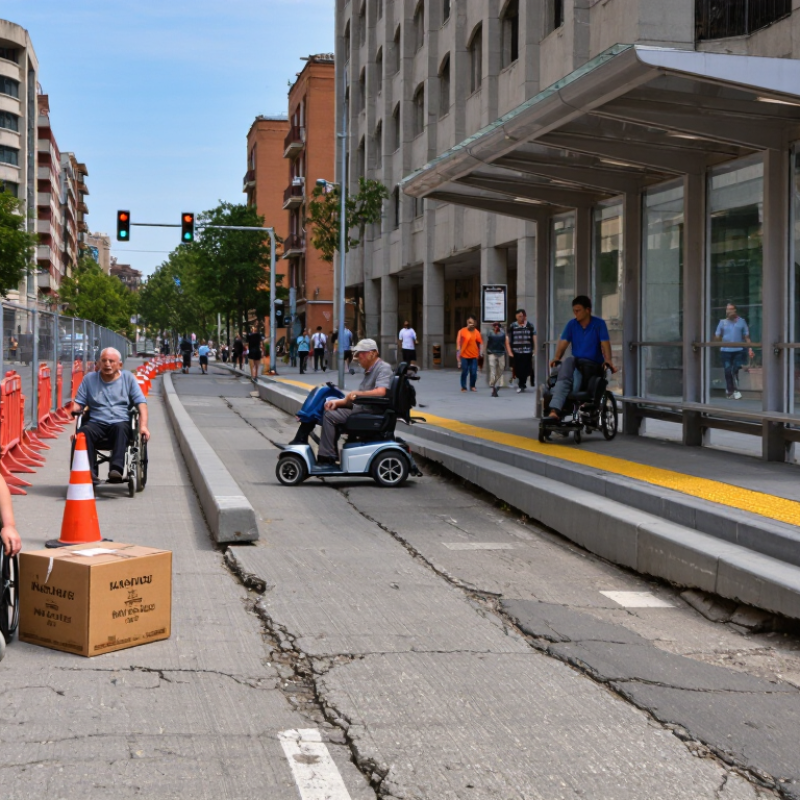
A city street can look accessible from across the road and still stop a wheelchair at the curb. A missing or badly aligned curb ramp forces a detour; a steep ramp can send wheels toward traffic. Cracked paving, loose gravel, drainage grates, and construction barriers add smaller hazards that accumulate over a trip. The World Health Organization and World Bank estimated that about 15% of the world’s population lives with a disability. That scale makes street access a basic planning need, not a special feature.
The World Health Organization and UNICEF reported in 2022 that 2.5 billion people need one or more assistive products, including mobility aids, and nearly one billion lack access. A wheelchair user may have to choose between a narrow sidewalk crowded with bins and a road edge with fast-moving cars. Rain can hide broken paving; a delivery vehicle can block the only usable ramp. Even a compliant curb cut is not enough if its landing is obstructed or its surface is uneven. Small details matter.
Cities often measure completed infrastructure, but less often record whether routes remain clear throughout the day. That gap deserves more attention. A map may show a continuous accessible path, while a single parked scooter or poorly placed sign breaks it in practice. Standards help, yet daily maintenance and feedback from wheelchair users matter just as much. The awkward truth is that access can fail in ordinary ways.
| Street feature or condition | What a wheelchair user may encounter | Why it creates a barrier | Relevant accessibility benchmark or response |
|---|---|---|---|
| Cracked, uneven, or narrow sidewalks | Broken pavement, abrupt level changes, or limited room to pass. | Small front casters can catch on gaps or uneven surfaces; rough routes can increase effort and make independent travel difficult. | In the United States, the 2010 ADA Standards generally require an accessible route to provide at least 36 inches (915 mm) of clear width, with limited exceptions. Maintain smooth, firm, stable walking surfaces. |
| Missing, steep, or poorly aligned curb ramps | A curb ramp may be absent, too steep, damaged, or positioned away from the crosswalk. | A curb can prevent access to the street crossing. A poorly aligned ramp may direct a person into traffic or make turning difficult. | U.S. ADA Standards specify a maximum 1:12 running slope for curb ramps, subject to the standards’ provisions. Ramps should connect to the crossing and include required level landings and detectable warnings. |
| Cross-slopes and slanted street surfaces | The sidewalk or crossing slopes sideways, often toward the road or a drain. | A wheelchair can veer downhill, requiring sustained correction and making it harder to keep a straight path. | The U.S. ADA Standards generally limit the cross-slope of an accessible route to 1:48. Street design should avoid abrupt or excessive sideways slopes along the usable route. |
| Obstructions and sidewalk clutter | Poles, signs, bins, parked vehicles, outdoor furniture, or temporary objects block the route. | Obstacles can force a detour, reduce passing space, or push wheelchair users toward traffic or an inaccessible surface. | Keep the accessible pedestrian route continuous and unobstructed, with the applicable clear width maintained. Place street furniture outside that route where practicable. |
| Long crossings and limited crossing time | A wide street, turning traffic, or a short pedestrian signal interval makes the crossing difficult to complete. | Wheelchair users may need more time to start, travel across the street, and reach the opposite curb ramp; exposure to moving traffic can increase stress and risk. | Provide accessible crossings, usable curb ramps, clear pedestrian signals, and crossing intervals appropriate to the crossing distance and applicable local accessibility requirements. |
| Construction and temporary street works | Sidewalk closures, barriers, equipment, or temporary surfaces interrupt the usual route. | A detour may have no curb ramp, be too narrow, or lead into traffic, making a normally accessible trip impassable. | Plan and maintain an accessible pedestrian route around work areas, with clear direction and safe connections at both ends, in accordance with applicable local requirements. |
| Rain, snow, ice, and standing water | Slippery surfaces, snow-covered curb ramps, puddles, or blocked drainage affect the route. | Reduced traction and hidden surface changes can make propulsion, braking, and transfers less safe. Water or snow can also conceal ramp edges and pavement damage. | Maintain sidewalks, curb ramps, and crossings; provide drainage and timely snow and debris removal. Keep accessible routes firm, stable, and usable in expected weather conditions. |
| Incomplete links between sidewalks and destinations | A sidewalk ends abruptly, does not connect to a crossing, or fails to reach a transit stop or building entrance. | Even an accessible segment cannot support a trip if the route is interrupted by a curb, road edge, or inaccessible connection. | Design continuous accessible routes that connect sidewalks, crossings, transit stops, and nearby destinations. Check the entire journey, not only individual sidewalk sections. |
Note: The barriers are common street-design challenges, not results from a single city survey. Numerical benchmarks in this table refer to the U.S. 2010 ADA Standards for Accessible Design; applicable requirements may differ by location.
A missing curb ramp, loose gravel, or steep landing can stop a trip. Rain can hide cracks. Small details matter.
Bins, parked scooters, construction barriers, and café tables can narrow sidewalks. A blocked ramp may force someone near moving traffic.
No. Its landing must be clear, and the surface should be even. A ramp beside a drain grate may still create a hazard.
A single step, heavy door, narrow turn, or broken lift can block access. High counters and toilets used for storage cause problems too.
Short signal times, blocked driver views, and uneven crossings can make travel risky. Level crossings and accessible signals help.
Snow, standing water, broken paving, and temporary barriers can make a designed route unusable. Maintenance matters.
They can ask wheelchair users to test routes at different times. Checks should include slopes, turning space, surfaces, and signal timing.
No. Different chairs and bodies may handle slopes or surfaces differently. I may be oversimplifying; one route will not suit everyone.
A 2022 global estimate puts the number above 2.5 billion. It includes many products, not only wheelchairs.
What are the challenges of using wheelchairs in urban environments? City streets can be difficult to navigate when sidewalks are narrow, uneven, blocked, or lack curb ramps and safe crossings. Steep slopes, construction, poor lighting, and heavy traffic may add physical effort and make independent travel less predictable. Public transportation can present further obstacles when stations, stops, vehicles, or boarding areas are inaccessible, unreliable, or difficult to use.
Access to buildings and essential services also depends on features such as step-free entrances, working elevators, spacious interiors, and accessible facilities. Urban design affects both safety and independence: well-maintained paths and clear routes can support mobility, while poorly planned spaces may create hazards and detours. Beyond the built environment, limited assistance, time pressure, and negative social attitudes can make everyday trips more stressful. Improving access across streets, transit, and public places can help wheelchair users travel more safely and participate more fully in city life.

 Kidvora Chair